|
|||



|
Ground Source Heat Pumps
|
||
|
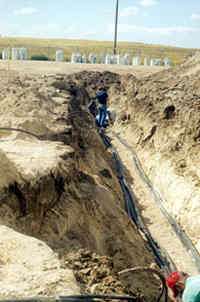
Using heat from beneath your feet! Only a few metres below the ground the temperatures stays at around 11-12 degrees Celsius throughout the year. Using ground source heat pumps (GSHP), this heat can be sourced to provide space heating in your home, and in some cases help pre-heat your water for your central heating system.
There are three key elements in a GSHP.
If you decide you would like to install renewable energy measures there is a wide range of funding sources available to help you. Information on the most appropriate funding source for an individual project can be obtained by calling the Green Energy Centre on 020 8683 6683. How much will a system cost me? For a professional installation of GSHPs, you should expect to pay somewhere between £800 and £1200 per kW of peak heat output, which does not include the cost of the distribution system. Trench systems tend to be at the lower end of the range, boreholes at the higher end. GSHPs are often cheaper to run (fuel wise) than oil systems or electric storage heaters. They are, however, more expensive than mains gas. Links The Heat Pump Association: part of the Federation of Environmental Trade Associations. Housing Energy Efficiency Best Practice Programme: provides a comprehensive new guide to GSHP system installation and design, called 'Domestic Ground Source Heat Pumps' (GPG 339), with in-depth coverage of financial, technical and efficiency benefits.
|
||
|