|
|||


|
Renewable Energy Technologies: Solar Water Heating
|
||
|
A great way to make your house more environmentally friendly The earth receives more energy from the sun in just one hour than is used by humans in a whole year. Why not use it? This energy comes to us for free, and the technology to capture is is now readily available. Daylight can be used to heat your home's hot water, reducing the need to exploit fossil fuels and thereby reduce the impact you have on the environment.
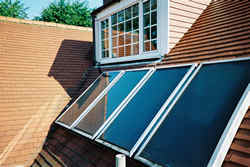
Why go Solar? Different Systems Flat plate or evacuated tube collector panels? Active or Passive? Open or Closed Loop? Installation Solar water heating uses heat from the sun to warm up liquid pumped through a panel on your roof. In the most common kind of system, this liquid then goes through a coil in a hot water cylinder where the heat is transferred to water that comes out of your hot tap. Most systems have a small pump that moves water around the system. Solar water heating should not be confused with photovoltaic systems which make electricity - see the separate section for information on this topic.
A solar water heating system is made up of three main components, solar panels, a plumbing system and a hot water cylinder.
Flat plate or evacuated tube collector panels? Solar panels are made up of either flat plates or evacuated tube collectors to absorb and retain heat from the sun's rays.
The fluid in the system can either be moved by a pump or be allowed to flow naturally. In a passive system the water moves by natural convective flows. In an active system the heated fluid is transferred to the hot water cylinder by a pump. Active systems are usually easier to fit but they may be more expensive. The collector panels can either directly heat the water that goes
to your taps or they can heat an intermediary fluid, which then
transfers heat to the water. You can choose to have the solar heater installed by a professional, which will take less than a day. This option benefits from a 5% VAT rate as well as our discount and interest-free loan schemes. See details of our installation programme here. The scheme we run ensures you get a hassle-free service from trained installers. The systems come with a 10-year warranty and require very little maintenance. Alternatively you can fit the system yourself. This option is charged
VAT at 17.5%. It can still work out cheaper (around £500 -£1,500)
but will take longer and requires a certain level of skills. You
can get training and support from your local solar club. To find
your local solar club call 0117 929 9404.
|
||
|