|
This page is designed to give
more information about CHP technology. It has two parts:
The benefits of the technology
CHP helps to reduce CO2 emissions. Using CHP on site
for heat and power emits less CO2 than using even the most efficient
condensing boiler and electricity from the grid. This is because
there are minimal transmission losses, and the excess heat from electricty
generation is directly used.
CHP also offers reduced fuel bills. As well as the opportunity for
financial savings, these can be passed on by housing providers to
their tenants.
Mini CHP can offer a low risk route to large scale CHP. Mini CHP
can be used as the first stage in a programme of more extensive CHP
use, enabling organisations to gain operating experience of CHP without
extensive capital outlay.
From the point of view of Local Authorities, CHP contributes to
Affordable Warmth strategies, and encourages take up of other energy
efficiency and renewable energy measures. It also stimulates the
local green economy: the potential market for mini CHP is large,
and the integrated design of mini CHP units enables local contractors
to be trained in mini CHP installation and servicing.
The components of
a mini CHP system
A Combined heat and power system is made up of the
following key components (summarised in the diagram below).
- Prime mover - an
engine to drive the generator
- Generator - to produce
electricity, which is fed into the building's power distribution
system
- Heat recovery system - to recover
usable heat from the engine
- Control system -
to maintain safe and efficient operation
- Enclosure - to achieve
physical and environmental protection for the engine and operators,
and to reduce noise.
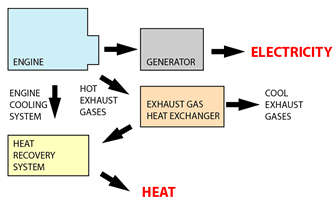
Components of a mini CHP system
|
Prime Movers
The prime mover is the engine. Prime movers for a small-scale CHP
scheme may be chosen from:
- Gas fired spark ignition engines
- Compression ignition engines (diesel)
- Gas turbines
Gas turbines in the UK at present are generally only economically
applicable for higher power applications.
The two main types of fuel are natural gas and diesel oil. The main
fuel available for natural gas installations is delivered by the
national pipeline system, but other gas fuels, biogas, landfill gas
or LPG may be available at some sites or as standby.
Generator
Generators create electricity by moving an electrical conductor
through a magnetic field. The electricity produced can be used directly
at the point of installation.
Heat Recovery
CHP engines produce heat as well as movement as the result of the
combustion of fuel. The heat that is not converted to electrical
output may be recovered. Heat is recovered from exhaust gases, and
from the engine cooling system.
Heat recovery, normally by heat exchanger to the appropriate building
services, is worthwhile in direct proportion to the amount of heat
that can be used. The overall thermal efficiency of the CHP scheme
may be as high as 90% where suitable uses can be made of the heat.
In many cases, however, it is not possible to use all the available
heat, and a lower efficiency will be achieved.
Control System
Control, instrumentation and monitoring of CHP systems is concerned
with:
- Ensuring that the CHP engine runs safely and efficiently
- Integrating the heat produced with the building heat systems
- Synchronising, paralleling and disconnecting the generator safely
- Monitoring the CHP plant for performance, maintenance and accounting
purposes.
Systems may be based on relay or solid state logic systems but are
increasingly designed around user-friendly microprocessor controllers
communicating with remote PC based control and monitoring stations,
often at the CHP plant supplier's offices.
Enclosures and Mountings
Engines used for CHP always require some form of enclosure and mounting
to provide protection from the elements and to reduce noise and vibration.
For more information
please contact us at chp@cen.org.uk or
by calling 020 8683 6677.
|