Forthcoming
events
CHP site visit, February 2006 Visit
to mini CHP installation and practical advice on CHP
- end user's experience on CHP.
Understanding New Building Regulations - Construction
Resources, London, March 2006 Theme:
using sustainable energy and renewables to meet policy
and building regulations.Includes
a tour of Construction Resources.
By popular demand! CEN biomass event for housing
associations, Thursday 2nd March 2006. This one-day event will
familiarise you with wood-fuelled heating systems and
includes a site visit to a biomass installation and
the Croydon Tree Station. Lunch and transport between
sites provided.
Aware
of changing planning policy in many UK authorities,
a large housing provider is working with CEN to ensure
that their newly planned developments comply. CEN has
worked with the housing provider on a number of sites
to assess the planning policy requirements with regard
to energy. Where a prescriptive energy requirement exists
in the Local Plan or Unitary Development Plan (e.g.
the development is expected to offset at least 10% of
the site’s CO2 emissions
through the use of on-site renewable energy), CEN assesses
which renewable energy technologies are feasible and
the costs associated with their supply and installation.
In many cases, a number of energy solutions are available.
Therefore, CEN works with the housing provider to identify
the ‘best value’ option, taking into account
initial capital outlay and cost savings for tenants
and homeowners.
This approach has enabled the housing provider to calculate
development build costs more accurately and to ‘design
in’ the appropriate technologies at the site feasibility
stage, thereby maximising cost savings.
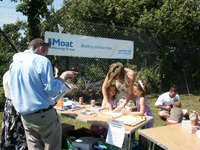
After
the installation of photovoltaic panels on the housing
association properties, CEN worked with Moat Housing to
run open days for visiting school children. CEN provided
materials for displays and coordinated workshop activities,
such as a Solar Car Challenge and the construction of
model wind turbines.
Working
with the client, CEN prepared and issued press releases
for the project.CEN was also commissioned to develop information
packs on sustainable energy in the home for distribution
to housing association tenants.
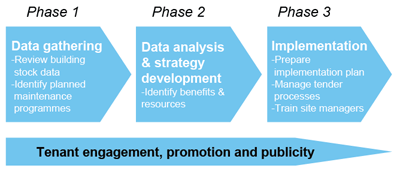
CEN
delivers an innovative method for assessing energy saving
and generation options for entire housing stocks.The
stock wide assessment procedure (SWAP) informs development
strategies for years to come.
CEN Recently conducted a SWAP of over 6,000 dwellings
for Maidstone Housing Trust, enabling them to identify
the most cost effective and innovative options and include
them in planned maintenance programmes. This strategic
approach allowed Maidstone Housing Trust to proactively
meet their targets and the regulations in relation to
energy.
The SWAP is as follows:
The
findings of the assessment include the following:
There are 164 southfacing roofs off the gas network
which could reap maximum benefits from solar thermal
panels
There
is great potential to improve energy efficiency
by changing the generation strategy from individual
to communal – 1540 properties could potentially
be included in heat networks.
CEN
also participated in an activity day in partnership
with Maidstone Housing Trust’s tenants. CEN
educated the tenants on energy efficiency and gave
out low energy lightbulbs.
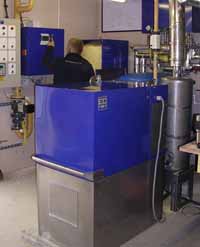
CEN
worked with Swale Housing Association to install one
of the first mini CHP systems in the UK. The system
not only provides residents at Abbeyfields Court with
reduced price heat and electricity, but is also estimated
to save over 13 tonnes of CO2
per year. To help facilitate the installation process
CEN has a package of assistance, including free and
impartial advice, site and feasibility assessments and
access to financial assistance.
Thanet District Council is a sustainable
energy champion and an excellent demonstration for other
social housing providers. The council is planning 14
installations of solar thermal, adding to the 6 systems
CEN helped install on their social housing in 2004.
CEN was once again asked to use its knowledge and expertise
to identify installers to tender for the work and to
technically, financially and environmentally review
all the quotes.
CEN found the lowest cost installer that also demonstrated
a proven track record in the installation of multiple
solar thermal systems. The installations are now planned
for the spring of 2006, subject to final approval. The
total solar project will save an estimated 76,000 kWhrs
of energy, an estimated saving for tenants of over £2000
per year and nearly 4 tonnes of carbon per year.
The
Sustainable Buildings Code, builds on the Existing EcoHomes
standard, and is intended to set an exemplar standard
for buildings that goes considerably further than the
minimum requirements of the building regulations. It
establishes a five star rating system, and is based
on six essential elements, including energy efficiency
and use of materials. All publicly funded homes will
need to comply with the code as of April 2006.
Comments are invited on the Code proposal – log
onto www.odpm.gov.uk/index.asp?id=1017165
to download the proposal and the comments form. The
deadline for responses is 6 March 2006.
Ofgem
has ruled that CHP, ground source heat pumps and solar
thermal will receive 50% uplift under Defra's Energy
Efficiency Commitment (EEC) for 2005 - 08. Under the
EEC, electricity and gas suppliers are required to achieve
energy saving targets by promoting improvements in energy
efficiency in housing stock including social housing.
Ofgem’s ruling means projects using the above
technologies count 50% more towards utility companies’
energy saving targets, therefore encouraging investment
in these technologies.
Low
Carbon Buildings Programme to Start in April 2006
The DTI’s £30 million Low
Carbon Buildings fund is to replace two previous government
schemes, the Clear Skies and Major PV Demonstration
programmes, which have disbursed about £43m over
the last four years. The EST has announced that the
final round of funding for the community grants under
the Major PV scheme is in February 2006, with both Clear
Skies and Major PV programmes due to come to an end
in March 2006. According to Energy Minister Malcolm
Wicks the new Low Carbon Housing programme will start
in April 2006, subject to State Aids clearance. The
grant fund will be managed by the Energy Saving Trust
on behalf of the DTI.
About
CEN CEN
has extensive experience in the design and implementation
of sustainable energy solutions for housing associations
and has worked with CHP, solar thermal, photovoltaics,
biomass heating, ground source heating and wind technologies.
CEN
works with social housing providers to access funding
from a range of utility and government funding streams,
allowing you to maximise the impact of limited budgets.
CEN also offers interest free loans and Energy Supply
Contracts.
For
further details please contact Catherine McNab on: 020
8683 8653



 CEN
worked with Swale Housing Association to install one
of the first mini CHP systems in the UK. The system
not only provides residents at Abbeyfields Court with
reduced price heat and electricity, but is also estimated
to save over 13 tonnes of CO2
per year. To help facilitate the installation process
CEN has a package of assistance, including free and
impartial advice, site and feasibility assessments and
access to financial assistance.
CEN
worked with Swale Housing Association to install one
of the first mini CHP systems in the UK. The system
not only provides residents at Abbeyfields Court with
reduced price heat and electricity, but is also estimated
to save over 13 tonnes of CO2
per year. To help facilitate the installation process
CEN has a package of assistance, including free and
impartial advice, site and feasibility assessments and
access to financial assistance.